Essential Music Theory Basics: A Complete Beginner’s Primer
Have you ever wondered why some songs make you feel like dancing while others bring you to tears? The secret lies in the language of music: music theory basics. Whether you’re an aspiring musician or a passionate listener, a basic understanding of music theory basics can add depth to your musical experience.
Key Takeaways
Music theory is an essential tool for creating and understanding music.
Learn the basics of musical elements like pitch, rhythm, melody & harmony to create recognizable phrases.
Develop ear training skills through online resources to apply music theory in practice!
The Importance of Music Theory

Music theory plays a vital role in understanding and creating music. It’s like learning the grammar of a new language. Sure, you can pick up a few phrases without it, but to really communicate, you need to understand the rules. And the more you learn music theory, the more you realize it isn’t a set of rigid rules, but a toolbox full of useful gadgets that enhance your creativity.
Learning basic music theory provides a solid foundation for exploring the vast landscape of music. It’s the compass that guides you through the wilderness, helping you understand the musical ideas you encounter and express your own. Moreover, formal music education greatly benefits from it as it provides a structured way to appreciate and comprehend music across different eras.
But how does music theory help in real life? Well, imagine you’re jamming with a band, and the guitarist says, “Let’s play a tune in E major.” Right away, you know what notes will sound good together, which ones to avoid, and how to create harmonies that lift the melody rather than clashing with it.
Understanding Musical Elements
Music, like any language, is made up of basic elements. Grasping these elements is akin to learning the alphabet prior to embarking on reading or writing. We will delve into each of these elements:
Pitch
Rhythm
Melody
Harmony
Dynamics
Pitch
Imagine you’re at a concert. The lights dim, the crowd hushes, and the first notes of the song fill the air. Those notes, whether high or low, are all about pitch. Pitch, determined by the frequency of a sound, is a fundamental aspect of music.
In music composition, pitch is the foundation for melodies, harmonies, and the emotional resonance of a song. It’s like the color palette for a painter, offering endless combinations for expressing your musical ideas.
So, how do we measure pitch? It’s all about the frequency of a sound wave, counted in cycles per second or Hertz (Hz). High-frequency sound waves are heard as high-pitched sounds, while low-frequency sound waves are heard as low-pitched sounds.
Rhythm
Think of your favorite song. Can you feel the beat, the pulse that makes you want to tap your foot or sway to the music? That’s rhythm. Rhythm structures music by organizing sounds and silences into patterns over time.
In today’s music, rhythm often comes from drums and beats, whether they’re acoustic drums, electronic drums, MIDI drum parts, or even handclaps and other percussion instruments.
Rhythm patterns can range from:
whole notes
half notes
quarter notes
eighth notes
sixteenth notes
triplets
syncopation
polyrhythms
specific genre rhythms
These patterns are represented in sheet music using symbols like notes and rests, with time signatures organizing the beats within a measure.
Melody
Ever found yourself humming a tune long after the music has stopped? That’s the power of melody. Melody is a sequence of musical notes that forms a memorable and expressive musical phrase.
Pitch and rhythm are the two main components constructing a melody. It’s the most recognizable part of a song, setting the vibe and bringing out feelings. It’s what sticks in our minds and hearts even after the song ends.
What methods do musicians utilize to create catchy melodies? They often start with a chord progression or a scale, building a melody around the notes in the chords or playing around with different scale patterns. Understanding how melodies work can help musicians create their own unique songs.
Harmony
Have you ever listened to a choir and noticed how the different voices blend to create a beautiful, rich sound? That’s harmony. Harmony occurs when multiple notes are played simultaneously, creating chords that support the melody.
In Western music, harmony is all about chords and chord progressions. A chord is a group of three or more notes, and a chord progression is a series of chords played in sequence. These progressions set the emotional tone of the music and play a significant role in how the music is perceived.
Dynamics
Ever noticed how some parts of a song are loud and intense, while others are soft and gentle? This variation in volume and intensity is known as dynamics, and it plays a huge role in expressing emotion and adding depth to music.
In musical notation, dynamics are indicated by terms like “forte” (play loud) and “piano” (play soft). To gradually increase or decrease the volume, musicians use terms like “crescendo” (gradually get louder) and “decrescendo” (gradually get softer).
The Musical Alphabet and Notation
Similar to how letters form words in a language, notes constitute melodies and harmonies in music. These notes are represented by the musical alphabet, consisting of the notes A, B, C, D, E, F, and G, and their variations, known as sharps and flats. Sharps raise the pitch of a note while flats lower it. Enharmonic equivalence is when notes sound the same but have different names, like C# and Db.
Learning to read musical notation is like learning a new alphabet. It helps musicians understand how to play a piece of music, including its pitch, rhythm, and dynamics.
Scales and Modes

Scales and modes serve as the building blocks of music. They consist of sequences of notes that provide the basis for melodies and harmonies. Understanding them is key to creating music that sounds good.
Major and minor scales, including the minor scale and major scales, are the most commonly used scales in Western music. They have their own unique patterns of whole and half steps that give them their distinctive sounds.
In addition to major and minor scales, there are also musical modes. These are like tweaked versions of the major scale, each with its own unique vibe. Understanding them can help musicians create more diverse and interesting music.
Chords and Progressions
As words are composed of letters, so too is music composed of chords. Chords, and the progressions they form, are the building blocks of music, providing structure and emotion.
We will explore the different types of chords in more detail.
Major Chords
Major chords, the sunshine of music, create a bright, uplifting sound with a major chord built using a specific formula: a root note, a major third, and a perfect fifth.
In comparison to minor, diminished, and augmented chords, major chords have a major third and a perfect fifth, giving them a happy, upbeat vibe.
Major chords are often used in lively music genres or to create a sense of contentment and resolution in a song. They can make you feel joyful, excited, and optimistic.
Minor Chords
While major chords are bright and uplifting, minor chords evoke a darker, more melancholic mood. They are formed differently from major chords, using a root note, a minor third, and a perfect fifth.
Minor chords are represented in music notation using the root note and adding ‘min’ or ‘m’, like Amin or Am for an A minor chord.
Minor chords are ubiquitous in all types of music, from classical to rock to jazz, making them an essential part of any musician’s toolkit.
Diminished and Augmented Chords
Diminished and augmented chords may be less common, but they add an intriguing layer of complexity to music. Minor and diminished chords, for example, consist of a root note, minor third, and a diminished fifth.
Augmented chords, on the other hand, consist of a root note, major third, and an augmented fifth. They create a sense of tension in music, often used to build up to a climactic moment or resolution.
Both diminished and augmented chords provide a unique sound that can add depth and interest to your musical compositions.
Key Signatures and the Circle of Fifths
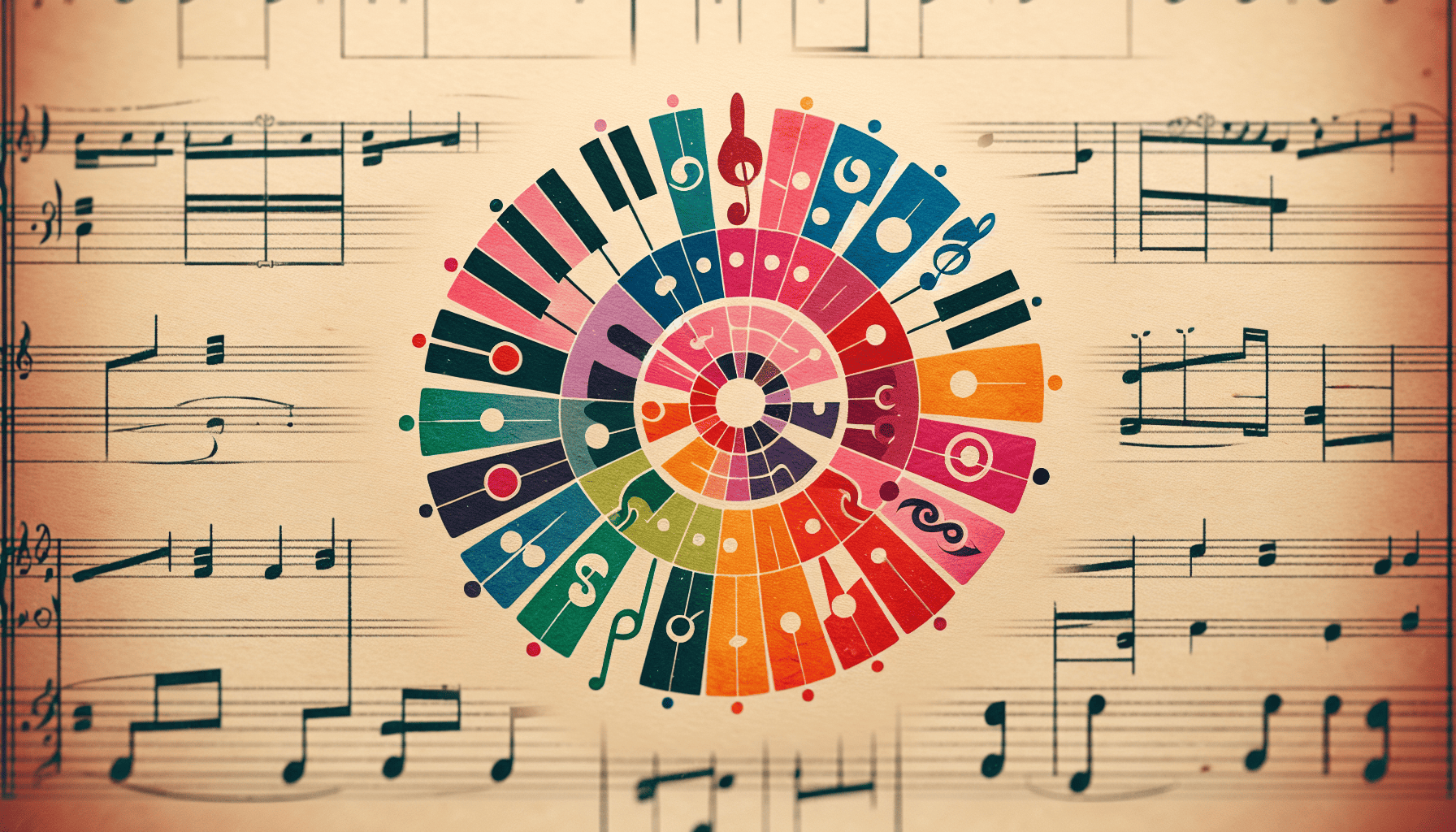
If we consider music as a language, key signatures can be compared to dialects. They indicate which notes in a scale are sharp or flat and help musicians understand the musical key of a song.
The Circle of Fifths is a handy tool that shows the relationships between different keys. It helps musicians figure out which keys are related and how many sharps or flats are in each key signature.
Understanding key signatures and the Circle of Fifths is paramount to understanding music theory. It’s like having a map that guides you through the world of music, helping you understand where you are and where you can go.
Rhythmic Concepts
Rhythm acts as the heartbeat of music. It’s what makes us tap our feet, sway our bodies, and feel the groove. Rhythm includes various elements like beats, meters, and time signatures, all of which create the rhythmic foundation of a piece of music.
Meter organizes beats into structured patterns, giving music a steady pulse that we can move to. It’s like the footsteps that guide us through the dance of music.
Tempo, on the other hand, is the speed at which music is played. It sets the pace of the music, working with the meter to shape the overall feel and energy of the piece.
Ear Training and Practical Application
Ear training can be compared to learning a new language through complete immersion. It involves recognizing musical elements such as intervals, chords, and melodies just by listening.
Ear training is particularly useful for songwriters, as it allows them to trust their instincts when writing music. It helps them translate the music they hear in their heads into real, playable music, by recognizing the notes played.
To practice ear training, there are many online resources available, such as the Notationist game in ToneGym. This game helps you improve your ability to read and understand music notation while also connecting it with the sound it represents.
Online Resources and Learning Methods
The internet brims with resources for learning music theory. Websites like musictheory.net offer comprehensive lessons on various aspects of music theory, making it an excellent resource for learners of all levels.
For younger learners, websites like musictheoryvideos.com, The Mighty Maestro, and Classics for Kids offer lessons and activities designed specifically for children. These resources make learning music theory fun and accessible, proving that it’s never too early to start learning music theory.
Summary
Understanding music theory is like unlocking a secret language. It enhances your creativity, improves your musicianship, and deepens your appreciation for music. From the basic elements of pitch, rhythm, melody, harmony, and dynamics to the complex concepts of scales, modes, chords, and key signatures, music theory provides a roadmap for exploring the vast landscape of music.
Whether you’re an aspiring musician or a passionate listener, a basic understanding of music theory can transform your musical experience. So why not start your music theory journey today? Who knows where it might lead you.
Frequently Asked Questions
What is the basic introduction to music theory?
Music theory covers elements such as harmony, melody, rhythm, song form, tempo, notes, chords, key signatures, intervals, scales, pitch, tone, timbre, texture, dynamics and more. It also includes fundamentals like melody, texture, rhythm, pitch, keys, and clef.
Where to start learning music theory?
To start learning music theory, familiarize yourself with the musical alphabet and how it is represented in music notation. This will help you connect what you hear to what you play by understanding intervals and distances between notes.
What is the importance of music theory?
Music theory is essential for understanding and creating music, enhancing creativity and playing a crucial role in music education.
What are the basic elements of music?
The basic elements of music are pitch, rhythm, melody, harmony and dynamics – essential ingredients that make our favourite tunes come alive!
How does ear training benefit musicians?
Ear training helps musicians recognize musical elements like intervals, chords and melodies by ear, which is especially helpful for songwriters when it comes to trusting their own musical instincts.